
Cheap Fixes That Could Stop an Ember From Getting Into Your House
Already worked through your yard zones? These fixes are the natural next step: protecting the house itself, not just the space around it.

You don't need a full home renovation to make your house harder to burn. That surprises people, because most of what gets talked about online — fire-resistant siding, new roofing, whole-home retrofits — sounds expensive and overwhelming. It can be. But some of the highest-impact fixes cost almost nothing and take an afternoon.
The idea behind all of them is the same: during a wildfire, it's usually not a wall of flame that takes a house down. It's a single ember finding a small gap and catching there, unnoticed, until it's too late. So the goal isn't to make your whole house fireproof — it's to close the specific small gaps embers use to get in.
Here are some of the cheapest, highest-value fixes.
Cover Your Vents
Every house has vents. Attic vents, crawlspace vents and foundation vents —most of them are just open mesh or slats built to let air through. That's exactly what lets embers through, too. A single ember landing in an attic vent can smolder inside your house for a long time before anyone notices anything's wrong.
The fix: cover vent openings with 1/8-inch metal mesh. It still lets air flow, but it's small enough to keep embers out. This is one of the cheapest fixes on this list and consistently one of the most effective. A small hardware store project, not a contractor job.
Clear Your Gutters
This one costs nothing but time. Dry leaves and pine needles sitting in a gutter are basically kindling waiting on a roof. Combine that with an ember landing in it, and you've got a fire starting somewhere you can't easily see or reach.
Clear gutters aren't just a spring-cleaning chore — during fire season, they're part of your home's defense. If you're in a high-risk area, it's worth checking them more than once a season.
Swap the Mulch Near Your House
Wood mulch is common right up against foundations and walkways, and it's exactly the kind of material that catches fast and burns close to the house. Swapping it for gravel, rock, or pavers in the area closest to your walls removes that fuel entirely.
This one matters most in the first few feet around your house, the same zone that does the most work in stopping embers before they reach anything flammable.
Why Small Fixes Add Up
None of these things alone will save a house on their own. Together, they close off the most common ways embers actually get in: through vents, through debris, through material sitting right against the walls. That's the whole point of home hardening: not one big expensive change, but a handful of small ones that remove the easy opportunities a fire looks for.
These can be done in a weekend-so stop putting it off and get out there!
Most Homes Don't Burn From the Fire Itself — Here's What Actually Gets Them
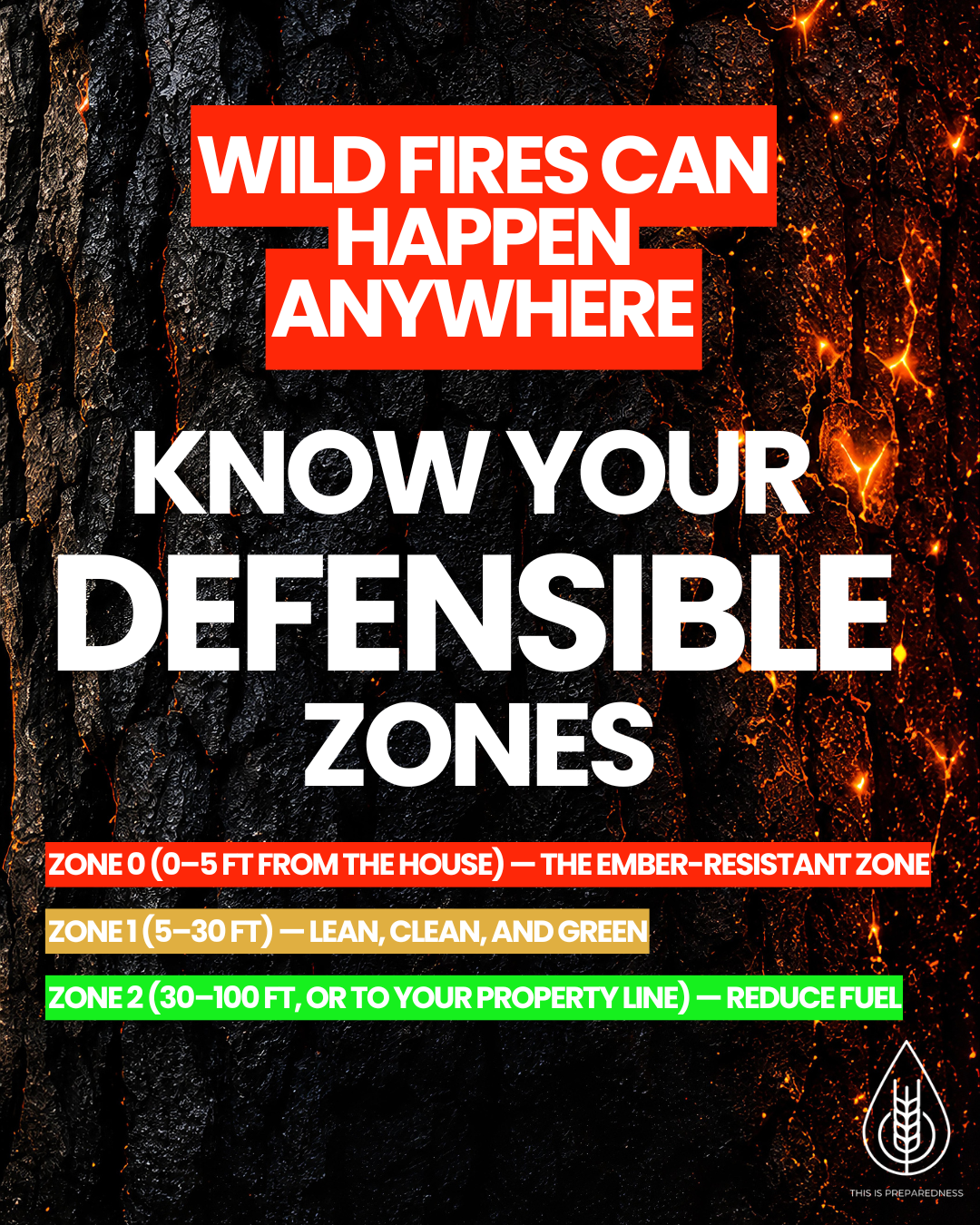
If you've done any wildfire prep at all, you've probably heard "clear your yard" more times than you can count. It's true, but it's also vague enough to be nearly useless. Clear what, exactly? How far out? Does it matter where I start?
It does. Defensible space isn't one big cleared yard. It's three distinct zones around your home, each doing a different job. And the zone that matters most is usually the one people skip entirely.
Zone 0: The First 5 Feet
This is the ember-resistant zone, and it's the one wildfire science points to as the single biggest factor in whether a home survives a fire. Not the flame front. Not the wall of fire you picture when you think "wildfire." Embers.
During a wildfire, embers can travel over a mile ahead of the fire itself, landing on roofs, in gutters, under decks, and right up against exterior walls — often long before any visible flame arrives. If there's something flammable sitting in that first 5 feet, an ember doesn't need a wall of fire to start a house burning. It just needs one dry, forgotten spot.
That means:
No mulch, plants, or shrubs within 5 feet of any wall — gravel, pavers, or bare soil instead
Gutters, roof, and deck clear of dead leaves and needles
Nothing combustible stored under decks or against the house
Wood fencing that touches the house replaced or broken up with a non-combustible section
This zone is small, which is exactly why it's easy to underestimate. It's also why it's increasingly required by law — California's AB 3074 mandates it in high fire hazard areas, and more jurisdictions are following. Check with your local fire department on what's actually required where you live, because this is changing fast.
Zone 1: 5 to 30 Feet — Lean, Clean, and Green
This is the zone most people already think of as "yard clearing." Grass mowed short, dead vegetation gone, space between shrubs and trees so fire can't hop from one to the next.
The detail people miss here is vertical spacing, not just horizontal. If a low branch sits close to the grass beneath it, or a shrub grows right up against the base of a tree, you've built a ladder — literally. Fire climbs it. Clearing branches up to 6 feet off the ground and removing vegetation growing under larger trees breaks that ladder before it forms.
Zone 2: 30 to 100 Feet — Reduce Fuel
By the time fire reaches this zone (or your property line, whichever comes first), the goal isn't elimination — it's reduction. Thin the trees so canopies aren't touching. Keep grass mowed. Clear dead fuel. You're not trying to make this area bare; you're trying to make sure fire arrives at your house zone with less intensity than it started with.
Why the Order Matters
Most people do this backwards. They tackle the big, visible outer areas first — the overgrown back fence line, the brush pile at the edge of the property — because it feels like the biggest job. Meanwhile the 5 feet closest to the house, the zone that actually determines whether an ember catches, goes untouched.
Start at the house. Work outward. If you only have one weekend this month, spend it on Zone 0.
This Isn't Just a California Thing Anymore
A lot of the language around defensible space — Zone 0, Zone 1, Zone 2 — comes out of California wildfire policy, and if you're outside California it might be tempting to treat this as someone else's problem. Given how dry and fire-prone much of the country is right now, that's a mistake. Many states in the western US are experiencing many wildfires as well as the southeast. No one is immune, they can happen literally anywhere. The physics of embers and ignition don't care about state lines. Treat this as the model fire agencies use everywhere, and check your own local requirements on top of it.