
Preparing Your Mind Is Part of the Plan
We talk a lot about kits and checklists- but what about the fear, the anxiety, and the stress that come with facing the unknown? Emotional preparedness is just as real, and just as important.
When we think about emergency preparedness, most of us jump straight to the practical or common areas: water, food, first-aid kits, documents. And yes — all of that matters. But, there is a piece of preparedness that often gets left out of the conversation entirely, and it might be the most important piece of all.
Here are some questions to ask yourself: How will you think clearly under pressure? How will you calm your children when they are scared? How will you keep going when the situation feels overwhelming? These are not small questions and do require some inner reflection and analysis. But the good news is you can prepare for them, just like you prepare for anything else.
The Emotional Side of Emergencies
Fear is a natural response to uncertainty. When disaster strikes, your nervous system goes into survival mode — heart racing, thoughts spinning, instincts taking over. That is not a character flaw, it’s biology. But when we have taken the steps to do the emotional work ahead of time, we give ourselves a fighting chance to respond rather than react.
Emotional preparedness means thinking through the hard questions before you are in the middle of a crisis. It means having conversations with your family now, so no one is hearing the plan for the first time when sirens are going off. It means building the mental and emotional muscle that makes clear thinking possible under pressure.
This is not about eliminating fear, it’s about building enough steadiness that fear does not make the decisions for you.
How to Emotionally Prepare
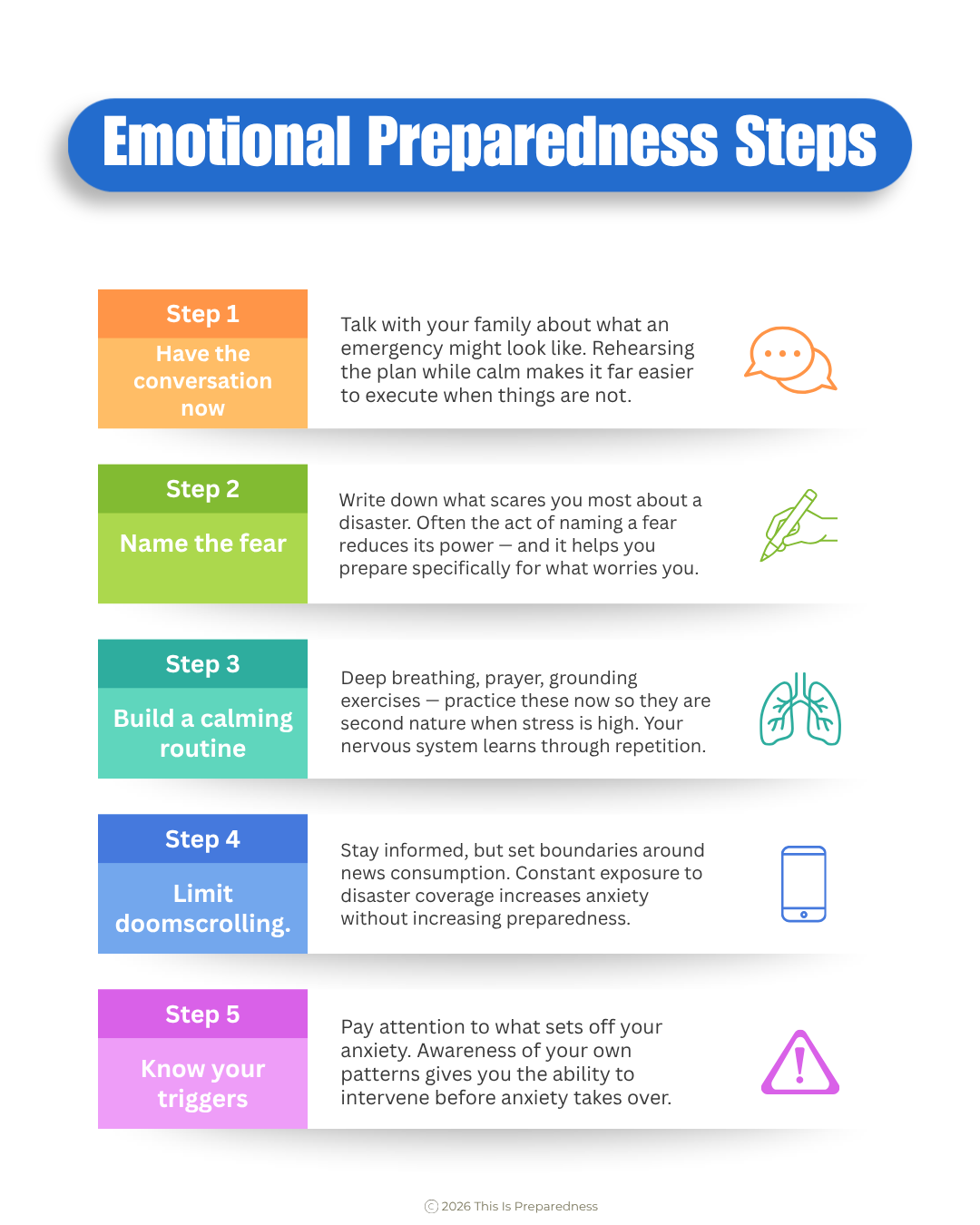
Step 1 — Have the conversation now. Talk with your family about what an emergency might look like. Rehearsing the plan while calm makes it far easier to execute when things are not. Do the fire drills, drive your evacuation route, establish your meeting location, etc.
Step 2 — Name the fears. Write down what scares you most about a disaster. Often the act of naming a fear reduces its power — and it helps you prepare specifically for what worries you. Use the scripture above as a type of mantra. Name the fear, read the verse. Do this over and over. In an emergency situation it can help calm your mind and emotional state.
Step 3 — Build a calming routine. Deep breathing, prayer, grounding exercises — practice these now so they are second nature when stress is high. Your nervous system learns through repetition.
Step 4 — Limit doomscrolling. Stay informed, but set boundaries around news consumption. Constant exposure to disaster coverage increases anxiety without increasing preparedness.
Step 5 — Know your triggers. Pay attention to what sets off your anxiety. Awareness of your own patterns gives you the ability to intervene before anxiety takes over.
Step 6 — Practice acting anyway. Courage is not the absence of fear — it is taking the next right step despite it. Build the habit of doing what needs to be done even when you are uncomfortable.
Talking to Your Kids
Children take their emotional cues from the adults around them. If you are panicked, they will be panicked. If you are calm and confident — even while being honest — they will feel safer. The goal is not to shield them from reality, but to give them age-appropriate information alongside the reassurance that your family has a plan.
For younger children: Keep it simple and concrete. "If something scary happens, here is exactly what we will do." Practice a fire drill. Show them where you keeo your 72 hr kit and supplies. Let them help pack it, participation helps build their confidence.
For older children and teens: Include them in the planning process. Ask for their input. Give them a real role in the family's emergency plan. Responsibility is empowering, and empowered kids are calmer kids.
Tools to Support Your Emotional Readiness
You do not have to figure this out alone! I have compiled a list here of some excellent free and low-cost resources designed to help individuals and families build emotional resilience. Discuss these resources with your friends and family. Print these out and post somewhere where every one can see it.
SAMHSA Disaster Distress Helpline — Free, confidential crisis counseling for people experiencing emotional distress related to disasters. Call or text 1-800-985-5990. Available 24/7.
Ready.gov — Coping with Disaster — The official FEMA resource on managing stress and emotional health before, during, and after emergencies. Includes guides for families and children.
American Red Cross Mental Health Resources — Free mental health support through Red Cross disaster response teams, plus online guides for building emotional resilience at every age.
"The Disaster Preparedness Handbook" by Arthur T. Bradley — A practical guide that addresses both the physical and psychological dimensions of preparedness. This is widely recommended, especially for families.
Calm & Headspace apps — I really like these apps. Both offer guided breathing, meditation, and stress management tools. Building a daily practice now means these skills are available to you when you need them most. They both offer a free 7 day trial.
Finding Peace in Purpose
For those whose preparedness is rooted in faith, emotional readiness takes on a deeper dimension. Preparing your family is an act of love and stewardship. It is not an expression of fear — it is an expression of care. Many people find that the very act of preparing brings a profound sense of peace, because it aligns action with values.
One of my favorite bible scriptures is John 14:27:
“Peace I leave with you, my peace I give unto you: not as the world giveth, give I unto you. Let not your heart be troubled, neither let it be afraid.”
You cannot control everything that happens around you. But you can control whether your family is ready.
Whatever your background or belief system, the emotional foundation of preparedness is the same: you are not preparing because you are afraid. You are preparing because you love the people in your life, and love takes action.