
The Highest-Impact Skills You Can Learn: First Aid and CPR
If you could do one thing this month to genuinely increase your family's safety — not in a theoretical, someday kind of way, but right now, in real life — it would be this: get certified in First Aid and CPR.
Not because emergencies are inevitable and not because you need to live in fear. But because the window between when something goes wrong and when help arrives is often 3 to 5 minutes — and what happens in that window matters more than almost anything else.
Cardiac arrest. Severe bleeding. Choking. These are not rare events that happen to other people. They happen at home, at the dinner table, in the backyard. They happen to children and grandparents and healthy adults without warning. In that critical window, the person who can help is almost always not a paramedic. It is someone like you.
WHY FIRST AID AND CPR MATTERS
Every minute that passes after cardiac arrest without intervention reduces survival rates by 7 to 10 percent. Bystander CPR can double or triple the chances of survival, yet fewer than half of Americans know how to perform it correctly.
Basic first aid knowledge: how to stop severe bleeding, how to treat a burn, how to help someone who is choking those cover the majority of emergency situations an average person will ever encounter. We are not training for wilderness survival. We are getting the training and skills that should be everyday knowledge in every home.
HOW TO GET CERTIFIED
Getting certified is far easier than most people think. The American Red Cross offers both in-person and online courses for First Aid, CPR, and AED use. Many courses can be completed in a single day, and prices range from free to around $30 to $80 depending on location and course level. (Visit redcross.org to find a class near you.) Take your spouse or partner and make it a double date!
The American Heart Association is another trusted source, particularly for hands-only CPR training and more advanced certifications. (Visit heart.org for course listings.)
Many local fire stations offer free community CPR training — call your nearest station and ask. This is an underused resource that most people do not know exists.
It is important to re-certify annually. CPR guidelines are updated periodically by the American Heart Association, and the physical skills — especially chest compressions and rescue breathing — fade much faster than you would expect without regular practice.
BUILDING YOUR FIRST AID KIT
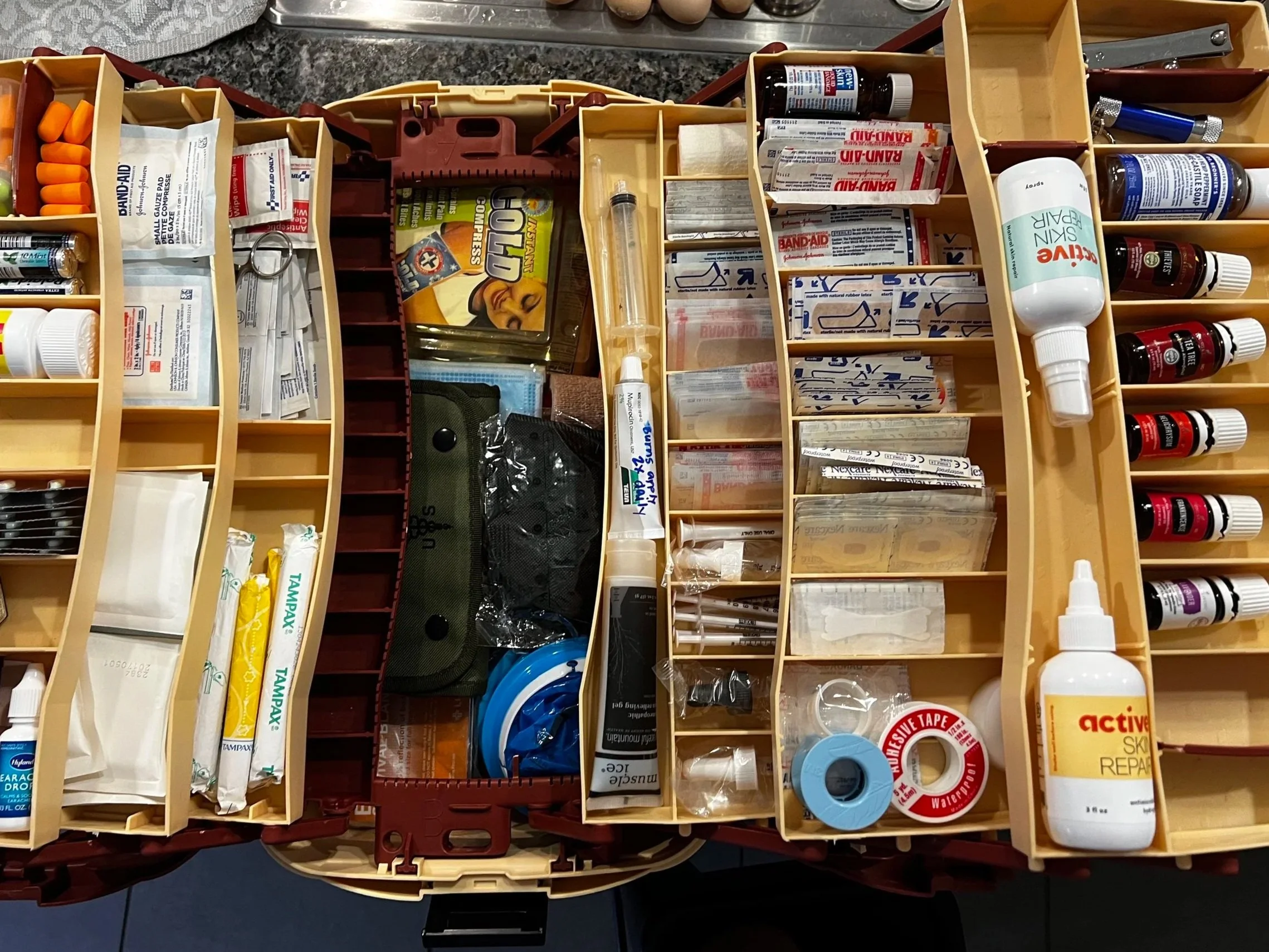
Knowledge matters. So do supplies. A well-stocked first aid kit at home and in your car means you can act immediately without scrambling. Check your kit every six months. Supplies expire, and at least in my home items get used without being replaced.
I have created a comprehensive list of what your home first aid kit should include: (CLICK HERE for FREE printable)
RESOURCES TO LEARN MORE
American Red Cross — redcross.org/take-a-class
American Heart Association — heart.org/cpr
FEMA Emergency Preparedness — ready.gov
Poison Control Center — 1-800-222-1222 (available 24/7)
Stop the Bleed Campaign — stopthebleed.org (free bleeding control training)
American College of Emergency Physicians First Aid guide — available at acep.org
This is your reminder that preparedness is not about fear at all. It is about love — for your family, your neighbors, your community. A few hours of training and a well-stocked kit could be the difference between a tragedy and a story you tell about the day everything was okay because someone knew what to do.
That someone can be you.
Are You Ready for Whatever Comes Next? The Case for Skill-Based Learning and Emergency Preparedness
Most people think about emergency preparedness the same way they think about going to the dentist — they know they should do it, they plan to get around to it eventually, and then life gets in the way. But here's the thing: skills aren't just for emergencies, they're for life. And the gap between people who have them and people who don't becomes painfully obvious the moment something goes wrong.
This post is about closing that gap.
Why Skill-Based Learning Matters
We live in a world of instant information. Any question you have can be answered in seconds with a quick search. And that's genuinely great — except when the power is out, your phone is dead, you're under stress, or seconds matter. In those moments, what you know beats what you can look up every time.
Skill-based learning is different from passive knowledge. It's not enough to have read about CPR or to vaguely remember a fire safety video from a workplace training years ago. Real preparedness means practicing skills until they become muscle memory — so that when the moment comes, your body knows what to do before your brain has finished processing the situation.
Consider this: 70% of Americans live in areas prone to natural disasters. The average fire department response time is around three minutes. A lot can happen in three minutes. The people who fare best in emergencies aren't the ones who panicked less — they're the ones who had practiced more.
The Core Skills Everyone Should Know
1. First Aid and CPR
This is the single highest-impact skill the average person can learn. Cardiac arrest, severe bleeding, choking — these events happen without warning, often in the home, often to people you love. The first 3 to 5 minutes are critical, and emergency services are rarely there in time to act during that window. You are.
Getting certified in CPR and basic first aid is easier than most people think. The American Red Cross and many local fire stations offer courses that are free or low cost. The investment is a few hours of your time, and the return is the ability to genuinely save a life.
A few things to keep in mind:
Keep a well-stocked first aid kit at home and in your car. Check it every six months — supplies expire and get used without being replaced.
Focus on the three most common emergencies: severe bleeding, burns, and choking. These cover the majority of situations you're likely to encounter.
Re-certify annually. CPR guidelines are updated periodically, and the physical skill fades faster than you'd expect if you're not practicing.
2. Fire Safety
Fire moves faster than most people imagine. In a modern home filled with synthetic materials, a fire can go from a small flame to a fully engulfed room in under two minutes. That's not meant to be alarming — it's meant to be motivating.
Know your home's exit points. Not just the front door, but every window, every route out of every room. Practice it with your family, including children. Know where your fire extinguisher is and, more importantly, know how to use it. The acronym PASS covers it: Pull the pin, Aim at the base of the fire, Squeeze the handle, Sweep side to side. It takes about ten seconds to learn and could save your home.
Review your fire safety plan every year. It's not a one-time conversation — families change, homes change, and habits drift.
3. Navigation and Communication
Here's a skill that has quietly eroded over the past two decades: the ability to navigate without a phone. GPS has made this feel unnecessary right up until the moment it becomes essential — a dead battery, a downed cell tower, a remote area with no signal.
Learn to read a paper map
Keep one in your car
Know the basic geography of your area well enough to get home or to a safe location without turn-by-turn directions.
And know your most important phone numbers by heart. Not saved in your contacts — actually memorized. If you ever need to borrow someone's phone in an emergency, you'll be glad you did.
4. Basic Home Repairs and Utility Management
When something goes wrong in a home — a burst pipe, a gas leak, a tripped breaker — the ability to respond quickly and correctly can prevent a minor problem from becoming a major one.
Know where your main water shutoff valve is and how to operate it.
Know where your electrical panel is and how to safely reset a breaker.
Know the signs of a gas leak and what to do if you suspect one.
These aren't advanced skills. Most of them can be learned in an afternoon with a YouTube video and a walk through your own home. But they require actually doing that walk-through, not just knowing it's something you should do.
5. Go Bag Readiness
A 72 hr kit or "Go Bag" is a pre-packed bag containing everything you'd need to leave your home quickly and sustain yourself for 72 hours. The goal is to be able to grab it and go in under two minutes — which means it needs to be packed in advance, kept somewhere accessible, and checked regularly.
A basic 72 hr kit includes water and water purification tablets, non-perishable food, a flashlight and extra batteries, a first aid kit, copies of important documents, cash in small bills, a phone charger and backup battery, a change of clothes, and any medications you take regularly. Tailor it to your household — if you have children, elderly family members, or pets, account for their needs too.
Check your 72 hr kit every six months. Rotate out food and water, replace expired medications, and make sure everything still fits your family's current needs.
Join our 10 week 72 hr Kit Challenge-HERE! Start today!
Building the Habit
The hardest part of preparedness isn't learning the skills — it's maintaining them. Here's a simple framework:
Every month: Practice one skill. Run through your home exit plan. Check your first aid kit. Review your emergency contacts.
Every six months: Rotate your Go Bag supplies. Review and update your emergency plan with your household. Refresh your CPR knowledge.
Every year: Recertify in first aid and CPR. Do a full home safety walkthrough. Update your documents and emergency contacts.
It doesn't have to be overwhelming. Think of it less like a checklist and more like a habit — the same way you maintain your car or your health, you maintain your preparedness.
The Bigger Picture
Skill-based learning is ultimately about agency. When you have these skills, you are not waiting to be rescued — you are the person who can help. You can treat the wound, navigate the route, calm the room, make the call, get the family out. That shift from passive bystander to capable responder is one of the most meaningful things you can invest in.
An ounce of prevention is worth a pound of cure — but only if you've actually practiced it.
What skill are you going to commit to learning or refreshing this month? Start there. One skill at a time is how you build the kind of preparedness that actually holds up when it matters.
Share this post with someone who'd benefit from a reminder. And drop a comment below — what's one skill you've been meaning to learn?